


Industrial production lines rely on continuous uptime. Automation enables companies to maximize output. Maintain faster speeds. No need for breaks. No repetitive motion injury concerns. However, mechanical processes can breakdown for various reasons. Don’t let unreliable, less durable electronic connectors be the cause of unplanned downtime.
Connector Impact:
Connector Impact in Industrial Automation:
Continuous, repetitive movements can impact industrial automation connectors and continuous uptime across industrial environments, and even cause a connector to stop working altogether. Vibration, motion stresses, high vibration, mechanical stress, electromagnetic interference, exposure to chemicals, and other harsh environmental conditions can cause connections to become loose or disconnected. A loose connection can degrade power or signal transmission, reducing reliable transmission across interconnected systems and impacting line efficiency, production output and quality. Disconnects stop production, so secure circular connectors are essential for reliable performance.
Featured Product Solution for Reliable Performance:
Whether it's servo motors or robotic applications, repetitive movement creates mechanical stress that can affect connector performance in automation environments. From precision measurement to material handling to packaging, identifying the right connector that will protect your equipment from continuous operation, high vibration, and harsh environmental conditions is critical to maintaining performance levels and keeping production on schedule. Loose or degraded connections can threaten reliable transmission and reliable performance, especially when power or signal paths are exposed to electromagnetic interference. In industrial environments, dust and moisture can cause signal attenuation, and exposure to chemicals and humidity can lead to corrosion. Connectors must also tolerate extreme temperatures from -55°C to +200°C.
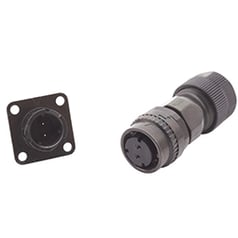
ElectroShield stocks a variety of reliable circular connectors from world-class manufacturers who design-in durability and performance characteristics required in industrial applications. Many of my industrial automation customers have successfully used Fujikura/DDK connectors. In particular, the DDK CM10 series are OEM-specified for servo motors and feature one-touch push-pull locking mechanism for vibration resistance and to ensure mated connectors remain locked. The CM10 ten position connector includes a grounded contact for equipment and user safety.
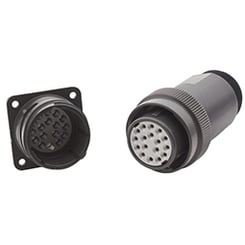
The DDK CE01 series connectors are OEM-specified for robotic applications, feature IP67 rated options, and quick disconnect bayonet coupling to prevent decoupling. The CE01 series connectors also include a first-make, last-break connection to protect the circuit and the operator.

|
CM10 Features
|
|
CE01 Features
|
Frequently Asked Questions
What types of connectors are used in industrial automation?
Connectors used in industrial automation applications play a crucial role in keeping automated assembly lines running smoothly. M8 and M12 circular connectors are the standard choice for sensors and actuators on the factory floor, while heavy-duty connectors combine power, signal, and data lines in a single connector housing for more complex equipment. D-sub connectors, available in sizes from 9 to 50 pins, are common in control systems and human machine interfaces, and Micro-D connectors — at less than a third the size of standard D-subs — are used in space constrained applications.
What's the difference between M8 and M12 connectors?
Both fall under the category of industrial connectors designed for motion control systems, but they're typically chosen based on space and pin configurations needed within a system. M12 connectors are engineered specifically to withstand harsh industrial environments — vibration, moisture, and dust — making them a common pairing with robotic systems and automated guided vehicles, alongside connectors like the DDK CM10 and CE01.
How many mating cycles can an industrial automation connector handle?
Durability varies by connector type, but push-pull style connectors — like the locking mechanism used on the DDK CM10 — are built to withstand over 5,000 mating cycles, giving them reliable performance even under high vibration and frequent connect/disconnect cycles during maintenance or changeovers.
Are industrial automation connectors rated for harsh environments?
Yes. Many circular connectors, including M12 types, are built with ingress protection to handle harsh environmental conditions like moisture, dust, and extreme temperatures. Some are Rugged Environment Certified for extreme conditions such as oil rigs and exposure to chemicals. The DDK CE01 series discussed above follows this same principle, offering IP rated protection to ensure secure connections in demanding industrial environments.
Can industrial automation connectors handle networking and Ethernet needs?
Yes — ruggedized industrial ethernet connectors support reliable transmission for ethernet connections in harsh settings, which matters more as industrial machinery becomes increasingly data-connected. These work alongside circular connectors and D-sub types as part of a complete reliable connectivity strategy across the plant floor.
What standards do industrial automation connectors need to meet?
Standards vary by connector type and application. For example, VULCON™ connectors conform to the DIN EN 61076 standard, while the DDK CE01 series referenced earlier is built to JIS-B 6015 Japanese Industrial Standards and carries UL approval — including protections related to electromagnetic compatibility and resistance to electromagnetic interference. Checking for the relevant standard is a key step in specifying the right connector for regulated or export-facing machinery.
How do I know which connector category fits my application?
Connectors are generally categorized by use case — M8 and M12 for sensor and actuator-level connections, heavy-duty and modular connectors for combined power, signal, and data needs, and D-sub or Micro-D for panel mount and interface connections. Factors like thermal expansion, mechanical stress, and contact resistance all affect which connector type performs best in your specific application. ElectroShield's connector experts can help match your environmental requirements to the right series, including options like the CM10 and CE01, to support operational efficiency and less downtime on the line.
Connect with us for Solutions in Harsh Industrial Environments
Our connector experts are available to assist you in identifying the precise connector for your specific application, including industrial automation applications that call for the right fit for machinery, motion control, control systems, and human machine interfaces. Work with us how you prefer…call in by phone at (800) 662-1054, email sales@electroshield.com or order at your convenience via our website, whether you need a standard option or a custom connector.
